Evidence plays a key role in proving fault in a bicycle dooring accident. Photographs, witness statements, video footage, and police reports can help establish how the collision happened, whether a driver or passenger opened a door unsafely, and who may be responsible. Although these accidents can happen in seconds, the available evidence can help show whether someone failed to check for approaching cyclists.
San Bernardino, located in San Bernardino County in California’s Inland Empire, has busy commercial streets and major routes such as Interstate 215 and State Route 210. Along streets with parked vehicles, cyclists may be struck when a driver or passenger opens a car door without checking for approaching bicycles.
Photos of the scene, witness accounts, and nearby surveillance footage can help establish how the dooring accident occurred and who may be at fault. Experienced San Bernardino bicycle accident attorneys can examine the evidence, assess whether a driver or passenger violated California law, and help determine how liability may be established.
Let’s have a deeper look!
Prosecuting A Violation of California Law
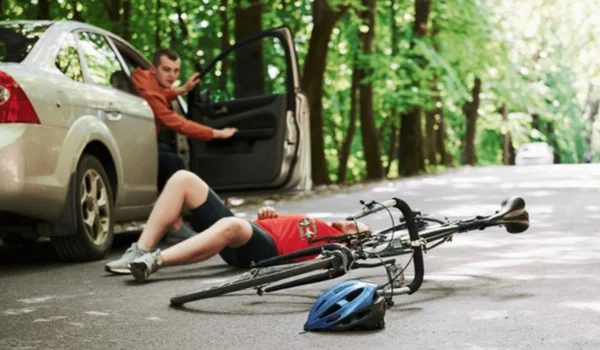
The California Vehicle Code deals with vehicle door opening in § 22517. It normally does not allow opening a door on the side of traffic while vehicles are moving, except if safe to do so, and it does not permit any door to remain open for more than is necessary to load or unload passengers.
This law could be an effective foundation for proving negligence when a driver or passenger forces a door open into an oncoming bicyclist. But investigators will have to determine the facts, such as whether the surroundings were clear, the traffic conditions, and if the cyclist could have avoided the crash.
Taking Physical and Video Evidence.
Information collected immediately following the collision will be useful in determining the circumstances of the dooring. Photographs should include the location of the vehicle, the accessibility of the open door, the damage to the bicycle, the markings of the road, and the availability of space for the bicycle to move around, if any.
Video footage could provide a clearer picture still. The door opening and the approach of the cyclist could be captured by nearby business security cameras, residential cameras, or bicycle-mounted cameras.
How to use Witness Statements and Police Reports
Independent witnesses will corroborate a cyclist’s version of the accident. If the opening of the door by a person who looked but did not look was observed, that observation may help prove that the action was unsafe.
The police report can also include the location, statements, visible injuries, and initial observations. The report is a valuable piece of evidence but will not prove legal liability and may require further records and witness statements.
Proving Negligence and Injury
To prove negligence and injury, you must establish all of the following elements:
Typical evidence establishing a successful claim involves proof that the responsible party had a “duty of care” for the claimant, a failure to perform that duty, and that the failure caused the claimant injuries, which led to losses.
Treatment bills, medical records, photographs of injuries, and proof of lost time at work can link the collision to the cyclist’s injuries. California has a pure comparative negligence system. This principle allows a cyclist to receive compensation even if they were partially to blame but also reduces the compensation by the amount of their fault.
A cyclist who determines that 20% of the responsibility rests with the bike owner may recover $8,000 for the loss.
Takeaways
- The term “unsafe vehicle door opening” is defined by California Vehicle Code § 22517.
- Take pictures of the scene, vehicle, bicycle, and injuries.
- Store security camera and bike camera footage.
- Take statements from the witnesses and the police report.
- Maintain medical and financial records.
Under California’s comparative negligence laws, if a cyclist is partly at fault, he may recover less in a personal injury case.