A company vehicle crash can trigger several obligations at once, and the most obvious one is not always the first that matters. Many employers immediately think about Cal/OSHA, but for a crash on a public street or highway, that reporting rule often works differently than expected. Meanwhile, workers’ compensation deadlines may already be running.
For employers trying to understand employer responsibilities after a company vehicle accident in California, the key is to separate the obligations by who they are owed to: the state, the employee, the claims administrator and potentially injured third parties.
That distinction matters for multi-state businesses as well. California uses its own reporting, workers’ compensation and reimbursement rules, and relying on procedures used elsewhere can create gaps when a crash happens here.
|
TL;DR |
|
After a company vehicle crash in California, employers may face several separate obligations with different triggers and deadlines. A public-road crash may fall outside Cal/OSHA’s eight-hour serious-injury reporting rule, while a DWC-1 claim form can be due within one working day and Form 5020 within five days for qualifying injuries. Employers should also check Form 300 recordkeeping duties, employee reimbursement obligations under Labor Code §2802, insurance coverage, and possible third-party liability. |
The Cal/OSHA Report You May Not Owe
A serious employee injury can trigger an immediate Cal/OSHA reporting duty, but a company vehicle crash on a public road is an important exception.
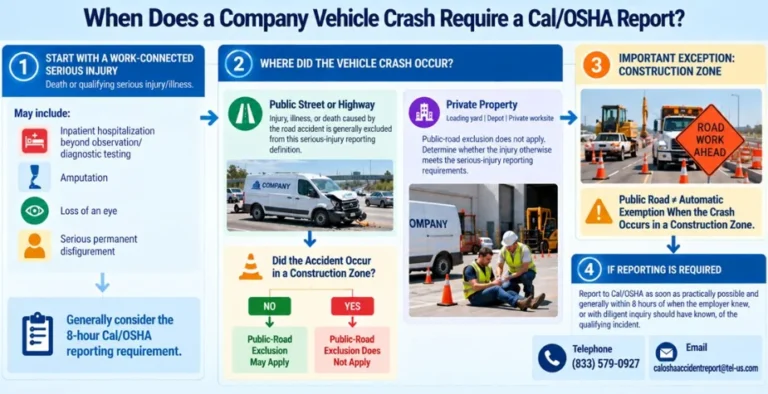
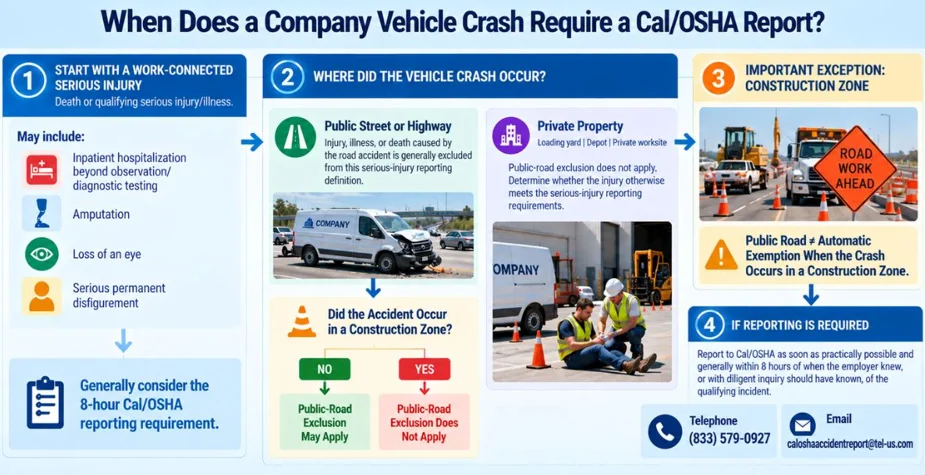
Under California law, employers generally must report a work-connected death or “serious injury or illness” to Cal/OSHA as soon as practically possible and no later than eight hours after the employer knew, or with diligent inquiry should have known, about it. The definition includes injuries involving inpatient hospitalization for more than observation or diagnostic testing, as well as amputation, loss of an eye, or serious permanent disfigurement.
But the same definition excludes an injury, illness, or death caused by an accident on a public street or highway, unless the accident occurred in a construction zone.
That distinction matters. If a delivery driver is hospitalized after an ordinary freeway collision while making deliveries, the crash generally does not fall within this particular serious-injury reporting definition. A qualifying injury in a private loading yard or depot is different because the public-road exclusion does not apply there.
The Construction-Zone Exception Matters
The public-street or highway exclusion does not apply when the accident occurs in a construction zone. Contractors, utilities, road crews, and other employers whose workers operate in or around roadway construction should therefore be especially careful before assuming a vehicle crash is excluded.
Cal/OSHA currently accepts serious-injury reports by telephone and also permits email reporting while its specified online reporting mechanism remains unavailable.
This is a narrow rule with fact-sensitive boundaries. Employers dealing with an actual serious vehicle incident should confirm whether the exclusion applies rather than assuming that every work-related road crash is either reportable or exempt.
The Clocks That Actually Start
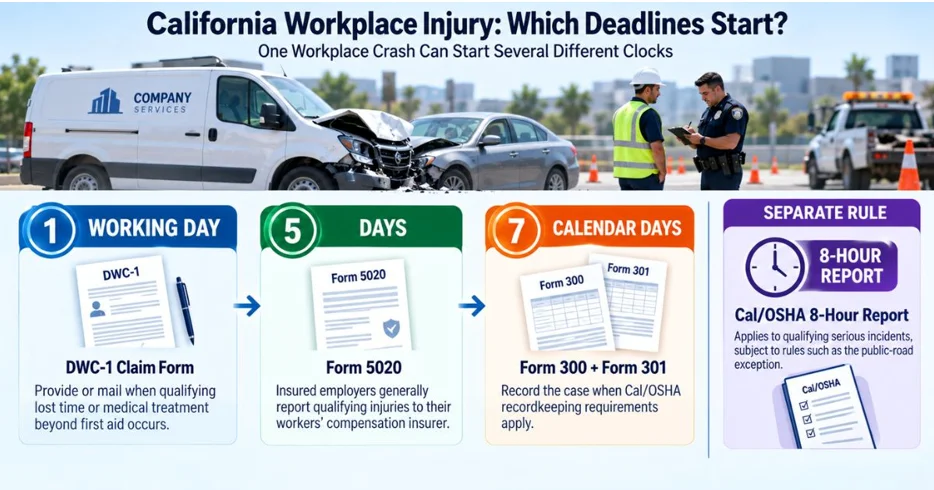
Even when a public-road crash does not trigger Cal/OSHA’s eight-hour serious-injury report, other California workplace obligations may already be running. For employers, the important deadlines can begin within a single working day.
One Working Day: Provide the DWC-1 Claim Form
When an employer receives notice or knowledge of a work-related injury that results in lost time beyond the employee’s work shift at the time of injury or requires medical treatment beyond first aid, Labor Code §5401 generally requires the employer to provide or mail the employee a DWC-1 claim form within one working day.
This duty can arise even before the employer knows whether the workers’ compensation claim will ultimately be accepted. Once the employee completes and returns the form, additional claims-handling duties begin.
Five Days: File the Employer’s Injury Report
A separate reporting obligation applies under Labor Code §6409.1(a) when a work-related injury results in lost time beyond the date of injury or requires medical treatment beyond first aid.
For an insured employer, the Employer’s Report of Occupational Injury or Illness, commonly called Form 5020, must generally be filed with the insurer within five days after the employer learns of the qualifying injury or illness. Self-insured employers have separate reporting procedures.
This is different from the Cal/OSHA eight-hour report discussed above. One concerns workers’ compensation and occupational-injury administration; the other concerns immediate reporting of qualifying serious injuries, illnesses, and deaths.
The Form 300 Log Has Its Own Clock
Recording is also different from reporting. Employers subject to Cal/OSHA recordkeeping requirements generally must enter a recordable work-related injury or illness on the Form 300, and complete the corresponding Form 301 or equivalent, within seven calendar days after receiving information that a recordable case occurred.
Not every employer is required to maintain a Form 300. Size-based and industry-based partial exemptions apply. But where recordkeeping is required, a crash can be recordable even when the public-street exclusion means it is not separately reportable to Cal/OSHA within eight hours.
What You Owe the Employee Beyond Workers’ Comp
Workers’ compensation is not the only employer obligation that can matter after a work-related vehicle crash. California Labor Code §2802 separately requires an employer to reimburse an employee for necessary expenditures or losses incurred as a direct consequence of performing their job duties.
The clearest vehicle-related example is an employee who uses a personal car for work. California courts have recognized that necessary automobile expenses can fall within §2802, including costs associated with operating a personal vehicle for business purposes. The method of reimbursement can vary, but the amount must be sufficient to cover necessary work-related expenses.
Section 2802 also expressly includes reasonable costs, including attorney’s fees, incurred by an employee enforcing their reimbursement rights.
That does not mean every expense or loss connected in some way to a company vehicle crash is automatically reimbursable. Whether a particular cost falls within the statute depends on why it was incurred and how directly it resulted from the employee carrying out their duties.
Workers’ compensation is also not always the end of the matter for an injured employee. If another driver caused or contributed to the collision, California law may permit a separate claim against that third party alongside the workers’ compensation claim. Resources published by PrestigeLaw.com discuss California injury claims from the injured person’s perspective, which can help employers understand why both tracks may exist after the same crash.
For employers, the practical point is to keep these obligations separate. Workers’ compensation addresses the employee’s work-related injury, while §2802 addresses qualifying expenditures or losses connected to performing the job. More complicated accident-related reimbursement questions should be reviewed individually rather than treated as automatic.
What You Owe Everyone Else
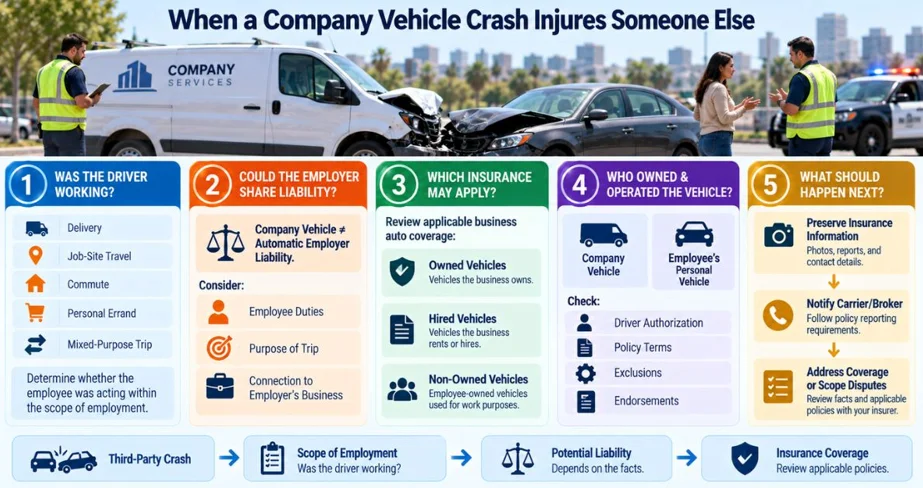
A company vehicle crash can also create obligations outside the employer-employee relationship. If an employee negligently injures another driver, passenger, cyclist, or pedestrian while acting within the scope of employment, the employer may face vicarious liability for the resulting harm.
The main issues employers should identify are:
– Whether the employee was acting within the scope of employment. A delivery between job sites may be treated differently from an ordinary commute, personal errand, or trip that mixed business and personal purposes. The analysis is fact-specific.
– Whether the employer may share liability. The fact that an employee was driving a company vehicle does not automatically establish employer liability. The circumstances of the trip, the employee’s duties, and the connection to the employer’s business can all matter.
– Which insurance policy may respond. Reviewing business insurance coverage is especially important as a company adds vehicles, drivers, or locations. Business auto policies can cover different categories of vehicles, including owned, hired, and non-owned autos, depending on the policy terms and coverage purchased.
– Whether a personal vehicle was being used for work. When an employee uses a personal vehicle for business purposes, employers should confirm whether applicable commercial or non-owned auto coverage may apply rather than assuming the employee’s personal policy will handle everything.
– Whether the driver was authorized under the policy. Driver status, exclusions, endorsements, and other policy terms can affect coverage even when the trip itself was work-related.
After a serious crash involving a third party, employers should preserve the relevant insurance information, notify the appropriate carrier or broker, and obtain legal advice when course and scope, driver authorization, or coverage is disputed.
The Policy Work That Has to Happen Before the Crash
The easiest time to decide who can drive, who handles a collision, and who files the required forms is before anyone is standing beside a damaged vehicle.
A practical company-vehicle policy should cover a few basics. Good fleet management starts with knowing which vehicles are in use, who is permitted to drive them, and who is responsible for operational decisions.
- An up-to-date authorized-driver list so only approved employees use company vehicles.
- Regular driving-record reviews. Some employers must use California’s Employer Pull Notice program for specified drivers; others may choose periodic checks as a fleet-management practice.
- Written driver-eligibility rules for license restrictions, suspensions, or serious driving-record issues.
- A short crash procedure in every vehicle covering who to call, what to photograph, and where insurance information is kept.
- A review of non-owned auto coverage for employees who use personal vehicles for work.
- Clear roles and responsibilities for compliance deadlines, including the one-working-day DWC-1 and qualifying five-day Form 5020 filings, with a backup person assigned.
The goal is not to create a large fleet manual. It is to make sure a small number of predictable decisions do not depend on whichever manager happens to be available when a crash occurs.
Who You Owe, and by When
A company vehicle crash can create several separate obligations. The fastest way to keep them straight is to identify who receives the form or report, what triggers it, and how quickly it is due.
California Company Vehicle Crash: Employer Deadline Checklist |
||
| Owed To | What | When |
| The Employee | DWC-1 Workers’ Compensation Claim Form, When the §5401 Trigger Is Met | Within 1 Working Day |
| Insurer / Claims Administrator | Employer’s Report of Occupational Injury or Illness, Form 5020, For Qualifying Injuries | Within 5 Days |
| Your Own Records | Form 300 And Form 301 or Equivalent, If the Employer Is Subject to Recordkeeping and the Case Is Recordable | Within 7 Calendar Days |
| Cal/OSHA | Serious Injury, Illness, or Death Report, When the Reporting Definition Applies and the Public-Street/Highway Exclusion Does Not Apply | As Soon As Practicable, No Later Than 8 Hours |
| The Employee | Reimbursement of Qualifying Necessary Expenditures or Losses Under Labor Code §2802 | No Single Fixed Filing Deadline; Address Qualifying Expenses As They Arise |
These obligations are separate. A crash may be exempt from Cal/OSHA’s 8-hour reporting rule but still trigger workers’ compensation or recordkeeping duties.
Each requirement has its own trigger and deadline, so employers should review them separately.
The Fastest Obligations Are Often the Easiest to Miss
After a company vehicle crash, employers may face several separate deadlines. A public-road collision may fall outside Cal/OSHA’s eight-hour reporting rule, while workers’ compensation paperwork can still be due within one working day or five days.
Assign responsibility before an incident happens. Know who handles the DWC-1, Form 5020, recordkeeping, and insurance notifications, with a backup in place if needed.
This article provides general information about California law and is not legal advice. Employers facing a live incident should obtain advice based on the specific facts.