
To truly grasp the paradigm shift meaning, we must look beyond the boardroom buzzwords and return to the philosophy of science. In 1962, Thomas Kuhn, a physicist turned historian of science, changed how we view intellectual progress through his seminal book, The Structure of Scientific Revolutions. He argued that science does not move in a straight, linear line of constant, cumulative improvement. Instead, it moves in fits and starts, punctuated by sudden, radical transformations that dismantle established orthodoxies.
Kuhn used the word “paradigm” to describe the shared set of techniques, values, conceptual frameworks, and beliefs that allow a scientific community to function. It is the “lens” through which we see the world and structure our inquiries. When that lens becomes cracked because it can no longer explain new empirical data, we experience a shift. Interestingly, linguist Margaret Masterson later analyzed Kuhn’s work and identified over 21 distinct ways he used the word “paradigm.” This ambiguity is perhaps why the term became so successful; it is open-ended enough to be applied to everything from theoretical physics to social sciences, economics, and politics.
Think of the famous “duck-rabbit” optical illusion popularized in philosophical discussions of perception. You can look at the same drawing and see either a duck or a rabbit. You cannot see both simultaneously, and when your perception “flips,” the entire image changes. A paradigm shift is the intellectual equivalent of that flip. Once you see the world through the new paradigm, you cannot go back to the old one, because the very facts and observations you are analyzing have been fundamentally reinterpreted.
Exploring the Paradigm Shift Meaning: Thomas Kuhn vs. Normal Science
Kuhn distinguished between two states of scientific life: “normal science” and “extraordinary science.” Normal science is the bread and butter of most researchers. It is what Kuhn called “puzzle-solving.” During these periods, scientists accept the existing paradigm as an absolute truth and spend their time “mopping up”—refining measurements, filling in minor gaps, calibrating instruments, and applying the established rules to new problems.
In normal science, the paradigm is not questioned. If an experiment fails, the scientist assumes they made a technical mistake or miscalculated a variable, not that the foundational theory is wrong. This is the “disciplinary matrix” that provides stability, pedagogical consistency, and institutional momentum. However, the paradigm shift meaning only becomes relevant when these puzzle-solving efforts consistently fail. When anomalies—data points that simply won’t fit into the prevailing theoretical framework—pile up, the community enters a state of crisis. The shift occurs when the old, rigid rules are abandoned in favor of a new, more robust framework that resolves the anomalies that the old one could not.
Incommensurability, Paradigm Paralysis, and Resistance to Change
Why don’t we shift paradigms the moment a better idea comes along? Kuhn identified a major barrier: incommensurability. This is the idea that two competing paradigms are so different that they cannot be directly compared using a neutral, shared language. They employ different terminologies, prioritize different questions, and occupy fundamentally different conceptual “worlds.”
This leads to “paradigm paralysis,” a state where we become so committed to our current model that we literally cannot see the evidence staring us in the face. This cognitive inertia is often linked to the “Semmelweis reflex,” named after the Hungarian physician Ignaz Semmelweis, who was ridiculed and ostracized for suggesting that hand-washing by doctors could prevent fatal postpartum infections. The medical community was so locked into their existing paradigm of disease that they rejected the life-saving evidence as offensive and absurd.
As physicist Max Planck famously noted, “Science advances one funeral at a time.” It is rarely the case that the old guard is convinced by the new evidence; rather, the proponents of the old paradigm eventually retire or pass away, and a new generation grows up with the new paradigm as their default starting point.
The Four Stages of the Kuhn Cycle: How Revolutions Happen
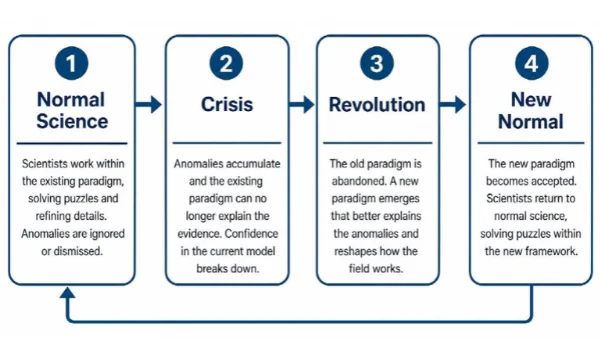
The life of a paradigm follows a predictable, if turbulent, path. We call this the “Kuhn Cycle.”
Pre-Science and Normal Science
In the beginning, a field may lack a unified framework. Once a dominant paradigm emerges, the field enters “normal science.” Here, practitioners share a common methodology and tacit knowledge. They don’t debate the fundamentals; they focus on the details.
Anomaly Accumulation and Model Crisis
Eventually, researchers encounter observations that defy the current model. At first, these are ignored as “noise.” But as they accumulate, they become “anomalies.” When the anomalies become too significant to ignore, the field enters a crisis. This is the stage of “extraordinary research,” where scientists begin to question the very foundations of their work.
Model Revolution and Paradigm Adoption
The revolution occurs when a new framework is proposed that accounts for the old data and the new anomalies. This is not a smooth transition; it is a conversion process. Once the new paradigm is adopted, it is institutionalized, and the cycle begins anew as the next generation starts the process of normal science within the new boundaries.
Paradigm Shift Examples Across Science, Medicine, and Culture
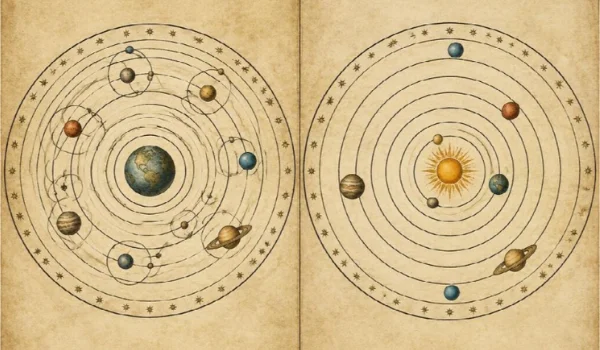
Natural Sciences: Astronomy, Physics, and Chemistry
The most famous example is the shift from the Ptolemaic (Earth-centered) to the Copernican (Sun-centered) model of the universe. For centuries, astronomers added complex mathematical “epicycles” to keep the Earth-centered model working. Copernicus simply removed the complexity by changing the perspective. In chemistry, Antoine Lavoisier revolutionized the discipline by dismantling the long-held phlogiston theory of combustion, establishing oxygen and precise mass conservation as foundational principles. Similarly, the transition from Newtonian mechanics to Einsteinian relativity showed that space and time were not fixed, but relative—a change that fundamentally altered how we build our technology today.
Applied Sciences, Medicine, and Psychology
In medicine, the shift from “miasma theory” (the idea that bad air caused disease) to “germ theory” saved millions of lives by introducing antiseptic practices, hygiene protocols, and targeted microbiological treatments. In psychology, the “cognitive revolution” of the mid-20th century moved the field away from behaviorism—which viewed the mind as a “black box” that could not be studied—to an information-processing model that allowed us to map the architecture of human thought.
Social Systems, Law, and Modern Culture
Paradigm shifts also occur in societal frameworks and legal doctrines. Take the shift in how we view human rights or disability. For a long time, the traditional “medical model” viewed disability solely as an individual physical deficit or pathology requiring clinical correction to fit normative standards. Today, we see a profound shift toward the social and biopsychosocial models, which argue that disability is largely constructed by systemic, architectural, and institutional barriers in the surrounding environment.
By understanding the paradigm shift meaning in this context, we can see how legal and social systems are evolving to prioritize inclusion, dignity, systemic accessibility, and structural accommodation rather than just clinical intervention. This movement reshaped modern jurisprudence, disability rights legislation, and workplace policies, demonstrating that a fundamental shift in theoretical framing directly generates real-world improvements in human agency, civil equity, and overall quality of life.
Distinguishing Paradigm Shifts from Other Forms of Change
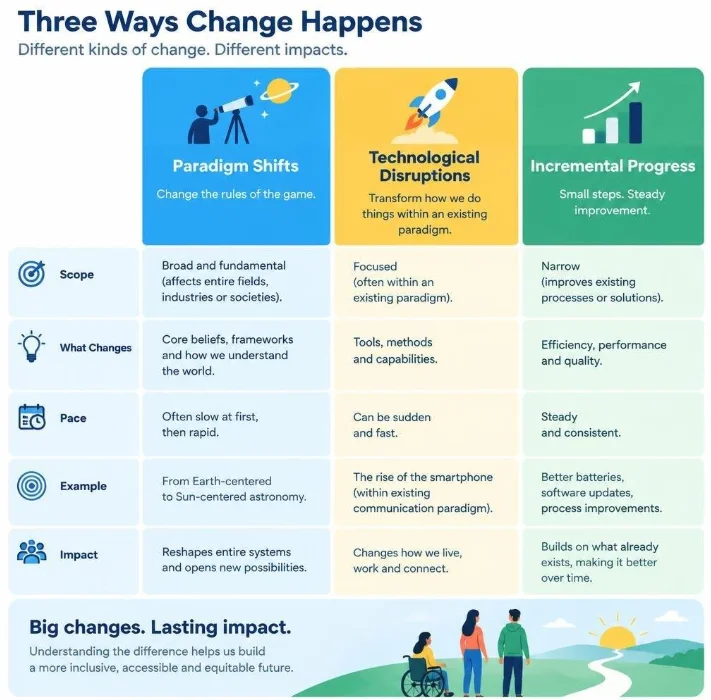
It is vital to distinguish between a true paradigm shift and other forms of change. A paradigm shift changes the rules of the game. A technological disruption, by contrast, often happens within an existing paradigm. For example, the invention of the smartphone was a technological disruption, but it didn’t necessarily change the underlying paradigm of human communication; it just made it faster.
Differentiating Individual Mindsets from the Macro Paradigm Shift Meaning
We often hear people say, “I had a paradigm shift,” when they mean they changed their mind or learned a new habit. While this is a “personal paradigm shift,” it is different from a macro-level scientific revolution. A personal shift is an internal, psychological transformation. A macro-level shift is a systemic, cultural, or scientific change that affects an entire community. Both are important, but they operate on different scales.
Paradigm Shift vs. Technological Disruption and Incremental Progress
Incremental progress is the “mopping up” we discussed earlier. It is essential, but it is not revolutionary. True paradigm shifts are rare. If we call every new product launch a “paradigm shift,” the term loses its meaning. A shift is only a shift if it renders the old framework obsolete.
Criticisms, Misconceptions, and Overuse of the Concept

The primary criticism of Kuhn’s theory is that it can lead to a form of relativism. If all paradigms are just “worldviews,” how can we say one is objectively better than another? Kuhn argued that new paradigms are better at problem-solving, which provides a standard for progress. However, critics like Larry Laudan have argued that science is more of a “research tradition” that evolves slowly, rather than a series of abrupt explosions.
Furthermore, the term has been heavily diluted by corporate culture. When a manager says, “We need a paradigm shift,” they often just mean “we need a new strategy.” This overuse risks turning a profound philosophical concept into a hollow buzzword. As Larry Trask pointed out, when a word is used for everything, it eventually means nothing.
Frequently Asked Questions About Paradigm Shifts
What is the simplest definition of a paradigm shift?
A paradigm shift is a fundamental change in the basic concepts, experimental practices, and underlying assumptions within a field. It is the moment when the “usual way” of doing things is replaced by an entirely new framework.
What role do anomalies play in triggering a paradigm shift?
Anomalies are the “canaries in the coal mine.” They are observations that the current paradigm cannot explain. When these anomalies accumulate, they create a crisis that forces the community to look for a new, more comprehensive model.
Can a single individual create a paradigm shift?
While a single individual (like Copernicus or Einstein) may propose the new idea, a paradigm shift only happens when the broader community adopts it. It requires a transition from individual discovery to collective consensus.
Conclusion
The paradigm shift meaning is far more than a linguistic tool for corporate presentations. It is a profound reflection of how we, as a species, handle the limitations of our knowledge. By recognizing that our current models are temporary, we remain open to the evidence that will eventually challenge them. Whether we are looking at the history of physics, the evolution of medical ethics, or the shifting landscape of disability law, the ability to recognize when it is time to change our perspective is the hallmark of progress. We must be willing to look at the “rabbit” and the “duck” with equal curiosity, knowing that the next great discovery lies in the space between our current assumptions and the reality that waits to be understood.