Hoodline reported that a crash near Everglades City left a boater seriously injured after a vessel struck mangroves. The outlet’s account of state data listed Florida’s 2025 totals as 694 reportable boating accidents and 51 fatalities.
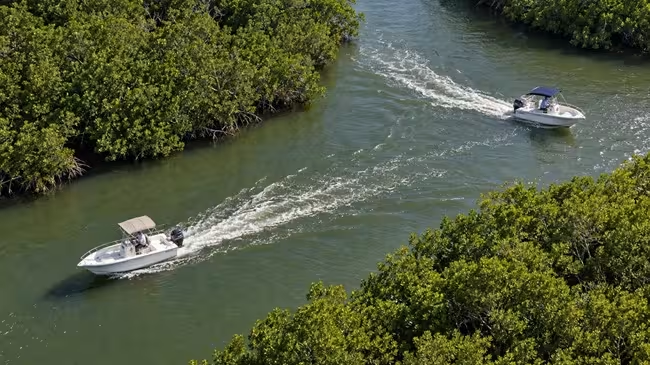
Florida determines fault in side collisions on crowded waterways by comparing each operator’s conduct with boating duties and tracing how the vessels moved. Investigators review physical evidence together with witness accounts. Civil responsibility depends on which failures caused the collision, while federal maritime law may affect the damages an injured passenger can receive.
How Florida determines fault in side collisions on crowded waterways
Investigators compare each vessel’s movements with the operator’s duties to identify which breach caused the collision or injury. A blow to a boat’s side doesn’t establish, by itself, that its operator was blameless.
Overall recreational boating incidents increased 1.1% from 3,844 in 2023 to 3,887 in 2024, according to the U.S. Coast Guard.
Florida Statutes section 327.33 requires operators to handle their vessels with care and prudence. Coast Guard Rules 5 through 8 cover lookout, safe speed, collision-risk assessment, and action to avoid collisions. A posted speed limit doesn’t mean that speed is safe in poor visibility. Investigators also consider whether wake effects or operator impairment contributed to the collision, along with whether a steering defect prevented a turn.
In side collisions on crowded waterways, hull contact marks and time-stamped footage help establish vessel movement at the collision site, including a last-second turn across another boat’s course.
Who must avoid a boat collision and how shared fault works
Both operators must act to avoid a collision; neither has an unconditional right of way. Rule 15 ordinarily requires a boat to keep clear if it has the other vessel on its starboard side when power-driven vessels cross in sight of each other.
Rule 16 directs the give-way vessel to take early, substantial action. Rule 17 generally requires the stand-on vessel to keep its course and speed. The rule allows that vessel to act to avoid a collision when the give-way vessel apparently fails to respond properly, and it requires action when the give-way vessel alone can no longer prevent the collision. Other rules apply to overtaking and encounters in narrow channels.
Both operators may share responsibility for the collision. A give-way operator might turn too late while the stand-on operator fails to react to immediate danger. Investigators must link each failure to the impact or resulting injuries, rather than base fault solely on the boats’ positions.
An injured passenger may have a claim against either or both negligent operators. A passenger doesn’t automatically bear responsibility for the operator’s negligence merely by being aboard. Anyone alleging that the passenger was at fault needs evidence of the passenger’s own conduct, such as interference with the controls.
What evidence can prove fault
Physical evidence and recorded vessel tracks can show how the boats moved before impact. Witness accounts help clarify what each operator could see and when a turn to avoid the collision became possible.
Collisions involving vessels, objects, or groundings were the first event in 56% of reported recreational boating incidents, 24% of deaths, and 54% of injuries in 2024, according to the U.S. Coast Guard.
| Evidence | What it may establish |
|---|---|
| Vessel damage | Contact angle and impact height, interpreted alongside hull shape and vessel movement. |
| Debris and final positions | A possible impact area, after accounting for drift following contact. |
| GPS and chartplotter data | Recorded course and speed, subject to clock settings and recording gaps. |
| Photographs and video | Vessel positions and visible conditions before or after impact. |
| Witness accounts | Observed turns or warnings, assessed against the witness’s vantage point. |
| Weather and water conditions | Visibility limits and the effect of wind or current on movement. |
| Maintenance records | Preexisting steering or propulsion problems and prior repair work. |
| Official reports | Investigators’ observations and measurements rather than a binding civil judgment. |
A single piece of evidence doesn’t necessarily settle the case. Starboard hull damage may show where the boats made contact, but it may not tell you which boat changed course. The electronic timestamps must show the same sequence of events that the witnesses describe.
Reporting and insurance after a Florida collision
You must follow Florida’s reporting rules and notify your insurer promptly, as your policy requires. Florida Statutes section 327.30 requires you to use the quickest available means to notify the Fish and Wildlife Conservation Commission or designated local law enforcement immediately if someone dies or disappears. You must also notify those authorities when an injury requires more than immediate first aid or when apparent property damage reaches $2,000 or more.
The statute also requires operators to remain at the scene and give whatever assistance they can without putting their vessel or anyone aboard in serious danger. Emergency care takes priority over gathering photographs.
You must keep the boat and original electronic records intact before starting any nonessential repairs. You should check who the adjuster represents before you give a recorded statement. Keep what you observed firsthand separate from your estimates, especially when you describe the other boat’s speed.
Coverage disputes turn on the policy’s terms, including what it excludes and which uses it permits. Your own insurer may have different contractual rights to cooperation than another operator’s insurer has. An insurer doesn’t conclusively determine legal fault by paying or denying a claim. Neither payment nor denial is a court judgment against either operator.
When federal maritime law can govern
Federal maritime law can govern a collision if the waters carry or can carry interstate or foreign commerce and the incident has a sufficient connection to maritime activity. A collision in Florida doesn’t settle jurisdiction just because it happened there.
The Supreme Court held in Foremost Insurance Co. v. Richardson, 457 U.S. 668 (1982), that maritime jurisdiction can cover collisions between pleasure boats. The boats need not carry commercial cargo.
Florida Statutes section 768.81(6) reduces damages for a claimant’s own fault in negligence claims it governs, and generally bars the claimant from recovering if that fault exceeds 50%. Courts generally apply maritime comparative fault rules to divide damages by fault, rather than use that cutoff. United States v. Reliable Transfer Co., 421 U.S. 397 (1975), holds that courts divide maritime collision damages by comparative fault when they can measure that fault.
State courts can apply federal maritime principles in deciding cases, and Florida law may resolve questions that maritime law leaves unanswered. Your lawyer should first determine which law governs, then calculate how a proposed fault percentage would affect your damages.
Remaining questions and next steps
Does a car side impact follow the same fault rules?
No, roadway-negligence law governs a side-impact car crash; the boating-collision rules don’t. The impact location alone doesn’t establish who was at fault. Traffic signals, along with each driver’s movements, may show who caused the crash.
Are 90% of accidents caused by the same thing?
No established percentage is universally valid for assigning nearly all accidents to one cause. You need a clearly defined accident category and a specific dataset that supports the claim before you draw conclusions about your collision from it.
How frequently do ferries have accidents?
You can’t determine how often ferries have accidents from recreational-boating totals. You can calculate a meaningful ferry accident rate only with ferry-specific incident counts and an exposure measure, such as passenger trips, covering the same period.
Which U.S. ferry disaster was the deadliest?
The recreational-boating data can’t tell you which U.S. ferry disaster had the highest death toll. You need records of ferry casualties to rank past disasters. You must treat scheduled ferries separately from other passenger-vessel operations, including excursion boats.
What most often causes death while boating?
The Coast Guard’s recreational-boating data identify drowning as the leading cause of death. A cause of death is distinct from conduct that contributes to an accident. Alcohol ranked first among known contributing factors in fatal recreational boating accidents in 2024.
You must make the required reports and preserve the evidence before repairs remove it. Ask your lawyer to assess which law governs before accepting a fault allocation or settlement, so you base your next decision on the collision record, not assumptions about which boat was struck.