Buying a newly built home is supposed to feel exciting and secure. But for some homeowners, problems begin shortly after moving in. One homebuilder that has faced lawsuits, consumer complaints, and construction defect claims over the years is D.R. Horton, one of the largest homebuilders in the United States.
Online searches about “DR Horton lawsuits” have increased as homeowners report concerns involving:
- Construction defects
- Water damage
- Foundation issues
- Mold problems
- Warranty disputes
- Delayed repairs
Many buyers now ask questions like:
- Why are people suing DR Horton?
- What are the most common homeowner complaints?
- Can homeowners sue for construction defects?
- What compensation may be available?
- Does a warranty prevent lawsuits?
This guide explains DR Horton lawsuit issues in simple language, including common legal claims, homeowner rights, and what buyers should know if they discover serious problems in a newly built home.
Who Is DR Horton?
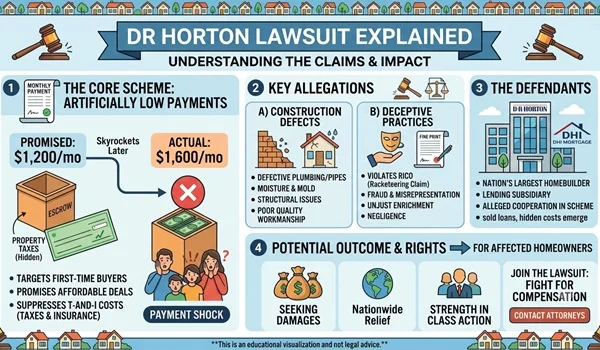
D.R. Horton is one of the biggest residential homebuilders in the United States.
The company builds:
- Single-family homes
- Townhomes
- Planned communities
- New construction developments
across many states.
Because the company builds a large number of homes nationwide, it has also faced a significant number of:
- Consumer complaints
- Warranty disputes
- Construction defect lawsuits
Like many large builders, the company disputes many allegations and continues operating nationwide.
Why Are Homeowners Filing Lawsuits?
Most lawsuits and complaints involving homebuilders generally focus on allegations such as:
- Poor construction quality
- Defective workmanship
- Water intrusion
- Structural problems
- Failure to complete repairs
- Misrepresentation during sales
Not every complaint becomes a successful lawsuit, but recurring issues can lead to:
- Individual lawsuits
- Class action claims
- Arbitration disputes
- Insurance litigation
Common Complaints in DR Horton Lawsuits
| Common Complaint | What Homeowners Often Report |
| Foundation issues | Cracks, shifting, settling |
| Water intrusion | Roof leaks, window leaks, moisture damage |
| Mold growth | Moisture-related mold problems |
| Plumbing defects | Pipe leaks and drainage issues |
| Poor workmanship | Cosmetic or structural construction concerns |
| Warranty disputes | Delays or denial of repairs |
Specific complaints vary heavily by location and subcontractors involved.
Construction Defect Lawsuits Explained
A construction defect lawsuit usually claims that:
- A home was improperly designed
- Materials were defective
- Workmanship failed to meet standards
Defects may involve:
- Structural systems
- Roofing
- Plumbing
- Electrical work
- Foundations
- Waterproofing systems
Some defects appear immediately, while others develop years later.
Water Damage and Mold Claims
One of the most common issues in homebuilder lawsuits involves:
- Water intrusion
Leaks around:
- Windows
- Roofs
- Plumbing systems
- Exterior walls
can eventually cause:
- Mold growth
- Wood rot
- Air quality concerns
Mold claims often become expensive because repairs may require:
- Demolition
- Remediation
- Temporary relocation
Foundation Problems in New Homes
Foundation complaints often include:
- Cracked walls
- Uneven floors
- Doors not closing properly
- Exterior brick cracking
Some settling is normal in new homes, but major structural movement can trigger legal disputes.
Foundation claims are especially common in areas with:
- Expansive soils
- Rapid development
- Extreme weather conditions
Are Warranty Programs Enough?
Most new homes come with builder warranties covering certain repairs for limited periods.
However, disputes may arise over:
- What is covered
- Repair quality
- Delays
- Denied claims
- Expired warranty periods
Some homeowners claim warranty processes become frustrating or incomplete.
Arbitration Clauses in Homebuilder Contracts
Many builder contracts include:
- Mandatory arbitration clauses
This means disputes may need to be resolved through private arbitration instead of public court lawsuits.
Arbitration can:
- Be faster than court
- Limit jury trials
- Affect legal strategies
Homebuyers often do not realize they agreed to arbitration when signing purchase contracts.
Can Homeowners Still Sue if There Is a Warranty?
Sometimes yes.
A warranty does not always eliminate legal rights.
Possible claims may involve:
- Breach of contract
- Negligence
- Fraud
- Construction defects
- Consumer protection violations
The available claims depend on:
- State law
- Contract language
- Warranty terms
- Nature of the defect
What Evidence Helps in Construction Defect Cases?
Strong evidence often includes:
- Inspection reports
- Repair invoices
- Photographs
- Emails with the builder
- Engineering evaluations
- Warranty requests
- Moisture testing reports
Documentation is extremely important.
Home Inspections and Expert Reports
Construction defect lawsuits often rely heavily on:
- Engineers
- Contractors
- Mold specialists
- Structural experts
Expert opinions may help determine:
- Cause of damage
- Repair costs
- Whether construction met industry standards
Are There Class Action Lawsuits Against DR Horton?
Some lawsuits involving large builders may become:
- Class actions
- Multi-homeowner claims
- Community-wide defect cases
This sometimes happens when:
- Multiple homes share similar defects
- The same subcontractor caused widespread issues
- Entire developments experience similar problems
However, many disputes remain individual cases.
Time Limits for Filing Construction Lawsuits
Every state has deadlines called:
- Statutes of limitations
- Statutes of repose
These laws limit how long homeowners have to sue.
Deadlines may depend on:
- Discovery of the defect
- Type of damage
- State law
- Contract terms
Missing deadlines can prevent recovery entirely.
Common Legal Claims in Builder Lawsuits
| Legal Claim | What It Usually Means |
| Breach of warranty | Builder allegedly failed to honor warranty obligations |
| Negligence | Construction allegedly fell below reasonable standards |
| Breach of contract | Terms of the purchase agreement allegedly were violated |
| Fraud or misrepresentation | Buyers allegedly received misleading information |
| Construction defects | Home allegedly contains unsafe or defective work |
Each case depends heavily on evidence and state law.
What Homeowners Should Do if They Discover Problems
- Document Everything
Take:
- Photos
- Videos
- Written notes
immediately after discovering problems.
- Notify the Builder in Writing
Many warranties require formal written notice.
- Get Independent Inspections
Do not rely only on the builder’s evaluation.
- Keep Repair Records
Save:
- Invoices
- Emails
- Contractor reports
- Speak With a Construction Defect Attorney
Lawyers familiar with homebuilder disputes can evaluate possible claims.
Why New Homes Still Develop Problems
Many buyers assume new homes are automatically defect-free.
But rapid construction, labor shortages, subcontractor issues, and tight building schedules can sometimes create quality-control problems.
Even large national builders may face:
- Supply chain issues
- Workforce shortages
- Inspection disputes
Common Myths About Homebuilder Lawsuits
“New Homes Never Have Major Defects”
False.
Even brand-new homes can develop serious issues.
“A Warranty Covers Everything”
False.
Coverage limits and exclusions often apply.
“You Can Wait Years Before Taking Action”
Dangerous assumption.
Legal deadlines may expire quickly.
“Cosmetic Problems Are Always Minor”
Sometimes cosmetic issues reveal deeper structural problems.
Frequently Asked Questions
Q: Why are people suing DR Horton?
A: Common complaints involve construction defects, water damage, foundation issues, and warranty disputes.
Q: Can homeowners sue over mold problems?
A: Possibly, especially if mold resulted from construction defects or leaks.
Q: Does arbitration prevent legal action?
A: Not necessarily, but it may change how disputes are resolved.
Q: Are construction defect lawsuits expensive?
A: They can be, especially when experts and engineering evaluations are required.
Q: Should homeowners get independent inspections?
A: Yes. Independent evaluations are often extremely important.
Final Thoughts
DR Horton lawsuit discussions reflect broader concerns that can arise in the new-home construction industry, especially involving construction quality, water intrusion, foundation movement, and warranty disputes.
While many homeowners are satisfied with their homes, others report serious issues that may require costly repairs or legal action. It is also important to remember that allegations alone do not automatically prove wrongdoing, and every construction defect case depends heavily on evidence, inspections, contracts, and state law.
For homeowners, the most important step is acting quickly when problems appear, documenting defects carefully, and understanding warranty rights before damage becomes worse or legal deadlines expire.