Seven firms from Manhattan, Brooklyn and Queens, the 2026 fees and wait times, and how to decide between a K-1 and a spouse visa
The fiancé visa lawyer New York City couples hire in 2026 spends less time on forms than on the order of the steps, because a couple on the K-1 path (many write it K1) now faces more decisions than couples did a few years ago. USCIS took a median of 8.5 months to decide a fiancé petition in fiscal year 2026, and the State Department has suspended visa issuance for nationals of 19 countries. Couples who could qualify either way also have to choose between marrying in New York on a K-1 and marrying abroad for a spouse visa.
The seven firms below all handle fiancé petitions for clients in the five boroughs, and they differ in ways that matter to two people planning across time zones: who prepares the couple for the consular interview, what a first meeting costs, which languages the staff speak and how the couple follows the case once it leaves USCIS. A table comes first for quick comparison, and a profile of each firm follows it.
Fiancé visa lawyers in New York City at a glance
| Firm | Where | Fiancé visa focus | First consultation |
|---|---|---|---|
| Marble Law | Online, with a New York location | K-1 planned as one continuous case; CR-1 route also handled | Free call |
| Oltarsh & Associates, P.C. | Manhattan (Midtown) | Full K-1 guide and a separate spouse-visa practice | Free case review |
| Ureña & Associates | Brooklyn (Greenpoint) | Mock consular interviews and a post-arrival checklist | Free in person; $250 by video, applied to the retainer |
| Cohen Immigration Law Group | Queens (Forest Hills) | Led by a former immigration judge | By appointment; price not stated |
| Kats Immigration Law PLLC | Brooklyn (Midwood) and Manhattan | Sample interview questions and document checklists | By video or phone; price not stated |
| Gehi & Associates | Queens (three offices) | Fiancé and K-2 children’s visas in eight languages | Free, by video or in person |
| Ajay K. Arora, Attorney-at-Law, P.C. | Manhattan (Midtown) | Posted $3,000 legal fee for a K-1 | Free online evaluation; paid phone calls |
Seven fiancé visa lawyers across the boroughs
#1 Marble Law

Marble Law treats the fiancé visa as one continuous case, which suits a couple split between New York and another country. Attorneys with Marble map five stages at the outset (a strategy review, the I-129F petition, consular processing, arrival and marriage, and adjustment of status), and the couple approves a fixed price for each service in advance, so both partners know what follows each stage and what it costs. The firm also handles the CR-1 spouse route for couples who decide to marry first. An attorney reviews immigration and travel history before filing and arranges the evidence in date order.
Marble Legal Engine™ technology matches the couple with an attorney for each stage and supplies insights drawn from 130,000+ completed legal services, although the technology supports that attorney’s judgment and never substitutes for it. Clients manage documents and updates in the Marble app, and the Marble Assistant answers everyday questions about the case at any hour, at no added cost. The attorneys average 15+ years of experience, and the firm accepts immigration cases nationwide while it maintains a New York location. Marble never bills by the hour or for messages and meetings, but its K-1 page doesn’t post a price, so a couple has to complete a free intake call before comparing Marble’s price with a published fee.
#2 Oltarsh & Associates, P.C.
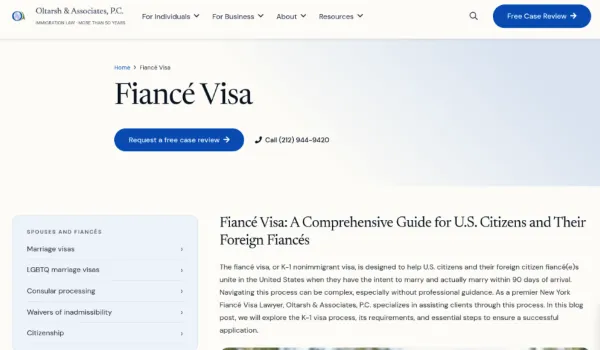
A Midtown Manhattan firm that traces more than five decades of immigration practice under the Oltarsh name, Oltarsh & Associates publishes a full fiancé visa guide for U.S. citizens and their partners. Jennifer Oltarsh joined the New York bar in 1993, has belonged to the national immigration lawyers’ association (AILA) since 1996 and founded the current firm in 2001. In its guide the firm explains the I-129F, the consular interview, work authorization, adjustment of status and the removal of conditions, and a separate page covers the spouse-visa route for couples who are still deciding whether to marry first. Every client has a lead attorney and a case manager, the team works in Spanish and Italian as well as English, and the firm sues in federal court over unlawful delays. It offers a free case review and publishes no fees.
#3 Ureña & Associates
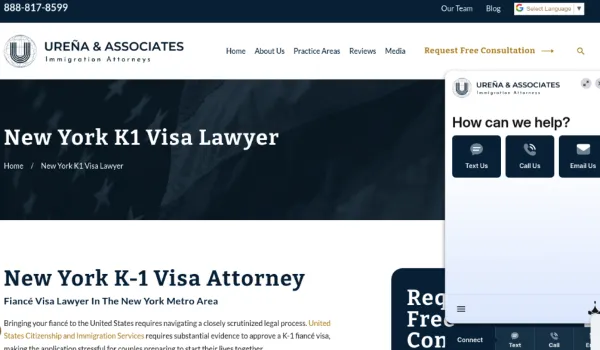
In Greenpoint, Brooklyn, Ureña & Associates stands out for saying what a first meeting costs. An in-person consultation at the Brooklyn office is free, and a virtual one costs $250, which the firm applies to the retainer when a client moves forward. Founder Rafael Urena began his career as an assistant district attorney in the Bronx before he moved to immigration law, and managing attorney Jana Al-Akhras now directs day-to-day case strategy. The firm runs mock interviews before the consular stage and gives couples a working checklist for the weeks after arrival, when they have 90 days to marry. Its K-1 page also covers the waiver of the in-person meeting rule, K-2 children and what happens when a couple misses the 90-day deadline. The firm, whose staff speak English, Spanish, Arabic, French and Portuguese, doesn’t publish its legal fee for a K-1.
#4 Cohen Immigration Law Group
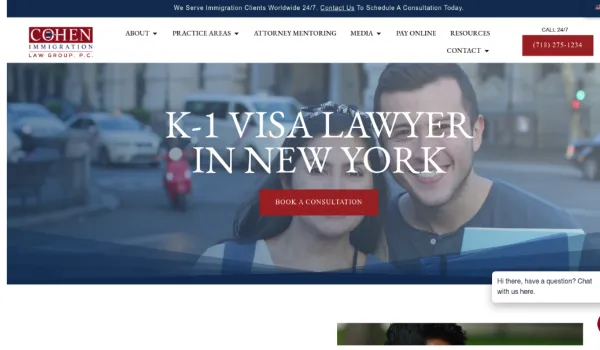
From Forest Hills, Queens, Cohen Immigration Law Group offers something unique in this group: a lead attorney who has decided immigration cases from the bench. Raisa Cohen served as assistant chief counsel for Immigration and Customs Enforcement in New York and then, from March 2016, as an immigration judge at the Federal Plaza court for almost a decade, and she first came to the United States as a refugee from Uzbekistan. On its K-1 page the firm describes help with the petition, the documentation and interview preparation, along with problems such as earlier immigration violations or inadmissibility grounds, and it says the firm serves clients across the country. Cohen belongs to AILA and to the Roundtable of Former Immigration Judges. The site invites readers to book a consultation and names no price, and its fees aren’t posted.
#5 Kats Immigration Law PLLC
With one office in Brooklyn’s Midwood neighborhood and another on Lexington Avenue in Manhattan, Kats Immigration Law gives couples a preview of the consular interview. Its K-1 page lists sample questions an officer may ask, such as whether the couple has planned the wedding and can prove it, along with a checklist of what to carry into the room: the DS-160 confirmation, the approval notice, the medical report and a police certificate. Alina Kats has practiced immigration law in the New York area since November 2016, and the firm describes its attorneys as AILA affiliates. The same page lays out the process in five steps and lists the documents a couple needs, including proof that the two met within the past two years. The offices stay open until 7 p.m. on weekdays, and clients outside the city can request a consultation by video or phone. The firm publishes neither a consultation price nor its fees.
#6 Gehi & Associates
Across three Queens offices in Jackson Heights, Jamaica and Ozone Park, Gehi & Associates competes on access. The firm is open seven days a week, offers free consultations in person or by video, and says its team is fluent in English, Spanish, French, Bengali, Creole, Punjabi, Gujarati and Afrikaans. The firm says AILA invited founder Naresh Gehi to join its federal litigation committee. On its fiancé page the firm answers the question many parents ask first, which is whether children can come too: a fiancé’s unmarried children under 21 can travel on a K-2 visa, provided the petition names them. Its lawyers claim over 60 years of experience between them, and the firm maintains a further office in Hicksville. Readers should know that it also runs a personal injury practice and that it publishes no fees.
#7 Ajay K. Arora, Attorney-at-Law, P.C.
In Midtown Manhattan, Ajay K. Arora is the only lawyer on this list who posts a legal fee for the fiancé visa: $3,000, listed next to the $675 USCIS filing fee in his published table. Arora has practiced immigration law since he earned his law degree at Temple University in 1993, takes only immigration cases and says he assumes personal responsibility as attorney of record on each one. In the same table he prices a later marriage-based adjustment at $4,250 and warns that answering a USCIS request for evidence costs $1,000 to $1,500 more. An online case evaluation is free, while phone consultations cost $250 for a 20-minute call or $400 and up for 30 minutes. The firm says it returns most calls the same business day.
What changed for K-1 couples in 2026
- USCIS now takes most of a year to decide the petition. The agency reports a national median of 8.5 months for the I-129F in fiscal year 2026, up from 7.7 months the year before, and that figure covers only the USCIS step, before the National Visa Center and a consulate each process the file.
- USCIS and the State Department kept the fiancé route’s fees steady. As of November 2026 the I-129F costs $675 and the K visa application costs $265, and USCIS changed none of the route’s filing fees in its October inflation adjustment. After the wedding, the green card application (Form I-485) costs $1,440 on paper or $1,390 online.
- Couples have to check nationality before they file. Under Presidential Proclamation 10998, the State Department has suspended visa issuance since January 1, 2026 for nationals of 19 countries and for travelers on Palestinian Authority documents, across nonimmigrant and immigrant categories, with limited exceptions. A couple that the suspension covers should talk to counsel before paying a filing fee.
- Lawyers must attend green card interviews in person. Since May 18, 2026, USCIS has barred attorneys from joining field-office interviews by phone or video, so a couple who wants counsel in the room for the adjustment interview needs a lawyer who can travel to it.
K-1 or CR-1: choose the route before you choose the lawyer
Couple immigration matters can have vastly different rules from other types of immigration processes, like those that govern business immigration. Couples can choose between the K-1 or CR-1 options and a couple who hasn’t married yet can use either route, and the routes differ in where the wedding happens and what the foreign partner can do on arrival. On a K-1, the fiancé arrives as a nonimmigrant with 90 days to marry and then applies for a green card from inside the country. On a CR-1 or IR-1 spouse visa, the couple marries first, and the spouse arrives as a lawful permanent resident who can work from the first day. Neither agency says which route is faster overall, so the choice depends on what the couple values most.
| K-1 fiancé visa | CR-1 or IR-1 spouse visa | |
|---|---|---|
| Marital status at filing | Engaged; wedding in the U.S. within 90 days of admission | Married before filing |
| USCIS petition | Form I-129F, $675 | Form I-130, $675 on paper or $625 online |
| USCIS median for the petition, fiscal 2026 | 8.5 months | 12.7 months |
| Status on arrival | Nonimmigrant, admitted for 90 days | Lawful permanent resident |
| Work | Needs a work permit (Form I-765) | Can work on admission |
| After arrival | Marry, then file Form I-485 | Pay the $235 USCIS Immigrant Fee; the green card arrives by mail |
| Fixed government fees, one adult | $2,380 | $1,355 |
Each total includes fixed government charges only: a K-1 couple pays for the I-129F, the $265 visa fee and a paper I-485, while a married couple pays for the I-130, the $325 immigrant visa fee, the $120 affidavit of support review and the Immigrant Fee. Couples on either route also pay for the medical exam, translations, travel and legal fees, which the table omits.
Marrying in New York City inside the 90 days
A couple has 90 days from the fiancé’s admission to marry, and USCIS can’t extend the period, so the couple should build the City Clerk’s rules into the plan. The Marriage Bureau issues licenses by appointment only, through its Project Cupid system, in person at one of five borough offices or by video, and both partners must appear together. The license costs $35, the couple must wait a full 24 hours before the ceremony unless a judge waives the wait, and the license expires after 60 days. A ceremony at the Clerk’s office takes place in person, costs $25 more and needs one witness who is at least 18. Each partner must bring one accepted form of identification, and a passport qualifies.
After the wedding, the foreign spouse files Form I-485 and can request a work permit with it for $260. The spouse shouldn’t leave the country while the application is pending without an advance parole document, because USCIS treats that departure as abandoning the application.
How to choose a fiancé visa lawyer in New York City
- Ask who prepares you for the consular interview. The interview happens at an embassy or consulate abroad, so a New York lawyer earns the fee in preparation, whether through mock interviews at Ureña, sample questions at Kats or a single case plan at Marble.
- Get the legal fee in writing before you sign. Only Arora posts a K-1 fee, and consultation terms vary between free and $400 or more for half an hour.
- Match the firm’s languages to your family. Gehi lists eight, Ureña lists five, and Oltarsh works in Spanish and Italian.
- Decide how both of you will follow the case. Partners in two countries need shared access to documents and status, so ask each firm how the partner abroad will see updates between the petition and the interview.
The right fiancé visa lawyer for a New York City couple
Every firm on this list files fiancé petitions, and the firms differ in what they do around the filing. Marble Law is the first entry because it plans all five stages and sets a fixed price for each service at the outset and manages the documents, the updates and the chat for the whole case in one app, which is what a couple in two countries needs most while USCIS spends a median of 8.5 months on the petition alone. Couples who want a posted fee can look to Ajay K. Arora, those who want a former judge’s read on a complicated history can call Cohen Immigration Law Group, and families who need a specific language have real choices in Queens and Brooklyn. Whichever fiancé visa lawyer in New York City you choose, settle the K-1 or CR-1 question first, because you can’t pick the forms, the fees or the wedding venue until you’ve chosen the route.