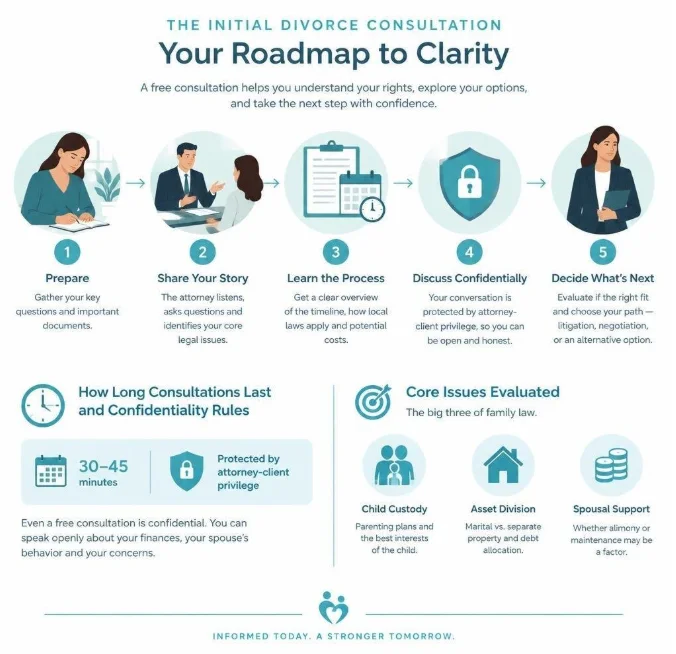
The primary purpose of an initial consultation is to bridge the gap between your current situation and the legal reality of your circumstances. You should view this meeting as a strategic diagnostic session. During this time, an attorney will listen to your narrative, identify the core legal issues, and help you determine whether your case requires aggressive litigation, a negotiated settlement, or an alternative path.

When you walk into—or log into—a consultation, you are not just seeking advice; you are evaluating whether this professional is the right fit to advocate for your future. The attorney will typically outline the procedural timeline required by your state, explain how local laws apply to your specific assets and custody concerns, and provide an overview of the potential costs involved.
How Long Consultations Last and Confidentiality Rules
Most free consultations are scheduled for 30 to 45 minutes. While this may seem brief, it is usually sufficient for an experienced lawyer to assess the complexity of your case. It is vital to remember that even in a free, initial, or “no-obligation” consultation, the conversation is protected by attorney-client privilege. You should feel safe disclosing the truth about your finances, your spouse’s behavior, and your specific concerns. This privilege exists to ensure you can provide the full picture, which is the only way an attorney can offer accurate, actionable legal advice.
Core Issues Evaluated: Custody, Asset Division, and Spousal Support
During your session, the conversation will likely pivot to the “big three” of family law: child custody, property division, and financial support. If children are involved, the lawyer will discuss the framework of a parenting plan and how courts in your jurisdiction prioritize the “best interests of the child.” Regarding assets, they will help you distinguish between marital and separate property and explain how debt allocation works. Finally, they will provide a preliminary assessment of whether alimony or spousal maintenance might be a factor based on the length of your marriage and the financial disparity between you and your spouse.
Preparing for Your Initial Meeting and Legal Strategy Review
Preparation is the single most effective way to ensure your free consultation is productive. When you arrive with a clear summary of your situation, you spend less time explaining the basics and more time discussing strategy.

How to Prepare for a Divorce Lawyer Free Consultation
To maximize your time, gather the following documents and information before your appointment:
- Financial Records: Recent tax returns, pay stubs, bank statements, and credit card statements.
- Legal Notices: Any court filings, letters from your spouse’s attorney, or protection orders you may have received.
- Relationship Timeline: A brief, chronological list of key dates, including your marriage date, separation date, and any significant events that might impact your case.
- Government ID: A driver’s license or passport to confirm your identity.
- A List of Goals: Write down exactly what you want to achieve. Are you looking for full custody? Do you want to stay in the family home? Are you worried about protecting a specific business asset? Having these goals written down keeps the conversation focused.
Crucial Questions to Ask About Fees, Strategy, and Retainers
Do not hesitate to ask direct questions about the business side of the relationship. Ask:
- “What is your hourly rate, and how do you handle itemized billing?”
- “Do you offer unbundled or limited-scope representation for specific tasks?”
- “Based on my case, what is your estimated timeline for resolution?”
- “How often will we communicate, and what is your preferred method?”
- “What is the typical retainer fee required to begin formal representation?”
Choosing Between Litigation, Dissolution, and Alternative Dispute Resolution
Not every divorce needs to be a courtroom drama. In fact, many couples find that staying out of court saves both money and emotional bandwidth.

Divorce vs. Dissolution and Grounds for Filing
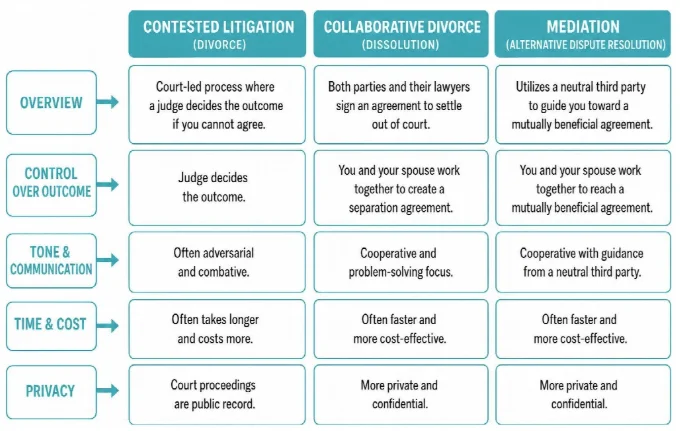
In many jurisdictions, there is a distinction between a “divorce” and a “dissolution.” A divorce is often the formal, court-led process where a judge decides the outcome if you and your spouse cannot agree. A dissolution, conversely, is an uncontested process where you and your spouse work together to create a separation agreement before filing. Your lawyer will explain the statutory grounds for divorce in your state—whether you are filing under “no-fault” (such as irreconcilable differences) or “fault-based” grounds (such as abandonment or cruelty)—and help you decide which filing status best suits your goals.
Collaborative Divorce and Mediation Pathways
If you and your spouse are willing to communicate, you might consider alternatives to traditional litigation. Collaborative divorce involves both parties and their lawyers signing an agreement to settle out of court, while peaceful divorce mediation utilizes a neutral third party to guide you toward a mutually beneficial agreement. These paths often preserve privacy and reduce the total cost of the proceedings.
Finding Affordable Legal Assistance and Free Representation Options
If you are concerned about the cost of representation, you are not alone. There are several avenues for finding affordable legal help.
How to Find a Divorce Lawyer Free Consultation Online or Locally
Start by checking your state or local bar association’s website. Most have lawyer referral services that can connect you with attorneys who specialize in family law and offer initial consultations. Many firms now offer virtual consultations, allowing you to meet with experts via phone or video call, which can save you time and travel expenses.
Low-Income Legal Aid, Pro Bono Clinics, and Unbundled Services
If your income is limited, you may qualify for assistance from organizations funded by the Legal Services Corporation (LSC) or local legal aid societies. Additionally, the American Bar Association (ABA) provides an online portal called “Free Legal Answers,” where low-income individuals can submit specific civil legal questions to be answered by volunteer attorneys. Some lawyers also offer “unbundled” services, where you hire them to draft specific documents or provide advice on a limited basis, rather than paying for full-scale representation throughout the entire process.
Frequently Asked Questions About Divorce Legal Consultations
Is an initial divorce consultation truly free and without obligation?
Yes. A “free consultation” is a marketing and discovery tool used by law firms to evaluate if they can help you and to see if you are a good fit for their practice. It does not create an obligation to hire the firm, nor should you feel pressured to sign a retainer agreement on the spot. Use this time to gather information; you have the right to speak with multiple attorneys before making a decision.
Can I attend an initial legal consultation remotely via phone or video?
Absolutely. In the current legal landscape, remote consultations are the standard. They offer convenience and allow you to meet with an attorney regardless of your geographic location. When booking, simply ask if the firm supports video conferencing or if they prefer a telephone call.
What is the primary difference between a contested divorce and a marital dissolution?
A contested divorce implies that you and your spouse disagree on one or more major issues—such as custody, support, or property—and will require a judge to make the final determination. A marital dissolution (often called an uncontested divorce) is a process where you and your spouse have already reached an agreement on all terms and are simply asking the court to formalize that agreement into a binding decree.
Conclusion
Taking the step to schedule a divorce lawyer free consultation is an act of empowerment. It moves you from a state of uncertainty into a state of planning. By preparing your documents, identifying your goals, and asking the right questions, you turn a daunting legal requirement into a manageable project. Whether you choose to pursue a traditional litigated path or seek a more peaceful divorce mediation, the information you gain in your first meeting will be the foundation for your next chapter. You deserve clarity, and a professional legal evaluation is the best place to start.