When rain returns to the San Fernando Valley, ordinary places change quickly. A tile entryway on Ventura Boulevard or a sloped parking lot in Van Nuys can turn slick within minutes. Nobody plans a fall. Still, California law sets clear expectations for the people who own and run property. Visitors have steps they can take too.
What California expects from property owners
The starting point is Civil Code section 1714. It makes everyone responsible for injuries caused by a lack of ordinary care in managing their property. California’s civil jury instructions turn that rule into a practical standard. Under CACI 1001, anyone who owns, leases, occupies or controls property must use reasonable care to keep it reasonably safe. That includes using reasonable care to discover unsafe conditions and to repair, replace or warn about them. That duty can reach a business that rents its space, not only the building’s owner.
Rain does not change the rule, but it can change what reasonable care looks like. For an owner or manager, steps like these can help during a storm:
- Put absorbent mats at entrances, and swap them out when they soak through.
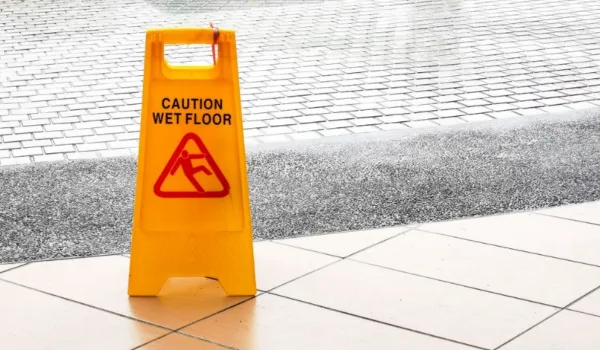
- Place wet floor signs where water tracks in.
- Clear leaves, mud and standing water from walkways, ramps and stairs.
- Check gutters, downspouts and drains before storms so water does not pour across a path.
- Keep a log of when staff check and clean each area.
Did the owner know, or should they have known?
A fall alone does not show that an owner did anything wrong. Under CACI 1003, three questions matter. Did a condition on the property create an unreasonable risk of harm? Did the owner know about it, or should the owner have known through reasonable care? And did the owner fail to repair it, protect against it or warn about it?
“Should have known” has a specific meaning. CACI 1011 asks whether the condition existed long enough that the owner had time to discover it. It also asks whether, using reasonable care, the owner could have fixed it, guarded against it or warned people in that time. For stores and other businesses, the instruction adds that the owner must make reasonable inspections. If no inspection took place within a reasonable time before the fall, that may show the condition existed long enough for a careful owner to discover it.
That is why inspection records matter to both sides. For an owner, a log can show the care taken. For a visitor, a gap in the log can be part of the story.
What to do after a fall
First, get checked by a doctor, even if you feel fine. Then, as soon as you can, start a simple record. Rain dries, puddles get mopped and mats get moved, so the scene may look different within an hour.
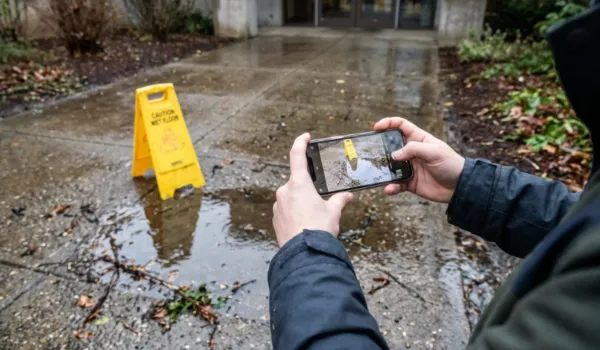
- Take photos of the spot, the floor or pavement around it, any warning signs, and your shoes.
- Get the names and phone numbers of anyone who saw the fall.
- Ask the manager to write an incident report, and ask for a copy.
- Write down the time, the weather and what you noticed before you fell.
- Keep the shoes and clothes you wore.
Also save any letters, emails or texts you receive from the owner or anyone acting for the owner.
Falls on public sidewalks and city property
Different rules apply when a city, county or other public agency owns the property. Under Government Code section 835, a public entity may be liable for a dangerous condition of its property. Among other things, the injured person must show one of two facts. Either a public employee’s negligent or wrongful act created the condition, or the agency had notice of it in time to protect against it.
The deadline is also much shorter. Under Government Code section 911.2, you must present a claim for personal injury to the public entity within six months. Those six months run from the date the cause of action accrues. A sidewalk, a library entrance or a bus stop may fall under these rules. So find out early who owns the place where you fell.
Every fall is different. For questions about your own, slip and fall attorneys in Los Angeles can go over the details and the deadlines with you.
About the author: Ivetta Avanesov is the founding attorney of Viciti Law in Sherman Oaks, California. The firm handles personal injury cases and insurance claim disputes, and it serves clients in English, Spanish and Russian. This article is general information, not legal advice.