Police officers make split-second decisions every day. But those decisions are not based only on training manuals or department policies — they are also shaped by court rulings.
In the United States, “case law” plays a huge role in policing. Court decisions from the Supreme Court of the United States and federal courts help define what police officers can and cannot legally do during traffic stops, arrests, searches, interrogations, and use-of-force situations.
For officers, understanding case law is critical because mistakes can lead to:
- Evidence being thrown out
- Lawsuits
- Department discipline
- Civil rights violations
- Criminal charges in extreme cases
For civilians, knowing these cases helps explain your constitutional rights during police encounters.
This guide breaks down the most important police-related case law in simple, everyday language without heavy legal jargon.
What Is Case Law?
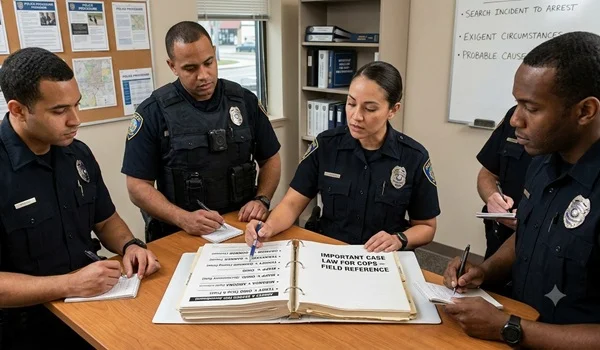
Case law refers to legal rules created through court decisions.
When judges interpret the Constitution or laws in real cases, those rulings become legal precedents that police departments and courts must follow.
For example:
- One court case may define when officers can search a car.
- Another may explain when force becomes excessive.
- Another may establish when suspects must hear their rights.
These rulings shape modern policing across the United States.
Why Case Law Matters for Police Officers
Police officers regularly deal with constitutional rights involving:
- Searches
- Seizures
- Arrests
- Interrogations
- Privacy
- Use of force
Case law provides the legal boundaries for these actions.
Without understanding case law, officers risk violating rights protected under:
- The Fourth Amendment
- The Fifth Amendment
- The Sixth Amendment
- The Fourteenth Amendment
Major Police Case Law Every Cop Should Know
- Miranda v. Arizona (1966)
Miranda v. Arizona is one of the most famous criminal law cases in America.
What the Case Established
Police must inform suspects of certain rights before custodial interrogation.
These include:
- The right to remain silent
- The right to an attorney
- The warning that statements may be used in court
This is where the famous “Miranda rights” come from.
Why It Matters
If officers fail to provide these warnings during custodial questioning, statements may be excluded from evidence.
- Terry v. Ohio (1968)
Terry v. Ohio created the rule allowing “stop and frisk.”
What the Case Established
An officer may briefly stop and pat down a person if there is reasonable suspicion that:
- Criminal activity is occurring, and
- The person may be armed and dangerous
Why It Matters
This case created a lower standard than probable cause for temporary investigative stops.
- Graham v. Connor (1989)
Graham v. Connor is one of the most important use-of-force cases.
What the Case Established
Police force must be judged under an “objective reasonableness” standard.
Courts evaluate:
- Severity of the crime
- Immediate threat level
- Resistance or flight
Why It Matters
This case is central in excessive force lawsuits.
- Mapp v. Ohio (1961)
Mapp v. Ohio applied the exclusionary rule to state police agencies.
What the Case Established
Illegally obtained evidence generally cannot be used in court.
Why It Matters
Officers must follow search and seizure laws carefully or risk losing critical evidence.
- Tennessee v. Garner (1985)
Tennessee v. Garner addressed deadly force against fleeing suspects.
What the Case Established
Police generally cannot use deadly force on a fleeing suspect unless the suspect poses a significant threat of death or serious injury.
Why It Matters
This case dramatically changed police pursuit and shooting policies nationwide.
- Arizona v. Gant (2009)
Arizona v. Gant limited vehicle searches after arrests.
What the Case Established
Police usually cannot automatically search a vehicle after arresting a driver unless:
- The suspect can still access the vehicle, or
- Evidence related to the arrest may be inside
Why It Matters
This ruling narrowed police search authority during traffic stops.
- New Jersey v. T.L.O. (1985)
New Jersey v. T.L.O. focused on searches in schools.
What the Case Established
School officials need “reasonable suspicion” rather than probable cause to search students.
Why It Matters
School resource officers often rely on this standard.
Quick Reference Table of Important Police Case Law
| Case | Main Legal Rule | Why It Matters |
| Miranda v. Arizona | Suspects must hear rights before custodial questioning | Protects statements in court |
| Terry v. Ohio | Allows stop and frisk with reasonable suspicion | Supports investigative stops |
| Graham v. Connor | Force judged by objective reasonableness | Key excessive force standard |
| Mapp v. Ohio | Illegal evidence may be excluded | Enforces search rules |
| Tennessee v. Garner | Limits deadly force on fleeing suspects | Protects constitutional rights |
| Arizona v. Gant | Restricts vehicle searches after arrest | Limits warrantless searches |
| New Jersey v. T.L.O. | Lower search standard in schools | Impacts school policing |
Understanding Probable Cause vs Reasonable Suspicion
Many police cases revolve around these two legal standards.
Reasonable Suspicion
A lower standard.
Allows:
- Temporary detention
- Brief investigation
- Pat-down searches in some situations
Example:
An officer sees suspicious behavior suggesting a crime may be happening.
Probable Cause
A stronger legal standard.
Usually required for:
- Arrests
- Warrants
- Major searches
Example:
Evidence strongly suggests someone committed a crime.
Understanding the difference is critical for lawful policing.
How Case Law Affects Traffic Stops
Traffic stops are heavily influenced by court rulings.
Police generally need:
- Reasonable suspicion of a traffic violation or crime
During stops, case law affects:
- Vehicle searches
- Passenger rights
- DUI investigations
- Use of K-9 units
- Detention length
Improper stops can lead to suppressed evidence.
Body Cameras and Modern Case Law
New technology continues shaping police law.
Courts now increasingly examine:
- Body camera footage
- Cell phone videos
- Digital evidence
- GPS tracking
- Social media evidence
Future case law will likely continue changing privacy and policing standards.
Qualified Immunity and Police Lawsuits
Another major legal issue for officers is qualified immunity.
This legal doctrine may protect officers from personal civil liability unless they violated “clearly established” rights.
Critics argue it protects misconduct.
Supporters argue it protects officers making difficult decisions in dangerous situations.
This remains one of the most debated legal topics in policing today.
Common Mistakes Officers Make Related to Case Law
- Conducting Illegal Searches
Improper searches can destroy criminal cases.
- Extending Stops Too Long
Traffic stops cannot usually be unnecessarily prolonged.
- Ignoring Miranda Requirements
Statements may become unusable in court.
- Using Excessive Force
Poor force decisions create major legal exposure.
- Poor Documentation
Reports and body camera evidence often become critical in court.
Why Police Training on Case Law Matters
Case law changes over time.
That is why officers regularly receive:
- Constitutional law training
- Search and seizure updates
- Use-of-force instruction
- Court decision briefings
Modern policing requires ongoing legal education.
Frequently Asked Questions
Q: Do police officers have to memorize case law?
A: Not every case word-for-word, but officers are expected to understand major legal principles affecting their duties.
Q: What happens if police violate case law?
A: Possible consequences include:
- Evidence suppression
- Lawsuits
- Discipline
- Criminal investigations in severe cases
Q: Can civilians sue over constitutional violations?
A: Yes. Civil rights lawsuits may be filed in some situations involving unlawful police conduct.
Q: Does case law apply nationwide?
A: U.S. Supreme Court decisions generally apply nationwide, while lower federal court rulings may vary by region.
Final Thoughts
Case law is one of the foundations of modern policing in the United States. Court decisions shape how officers conduct searches, make arrests, question suspects, and use force.
For police officers, understanding these legal rules is essential for effective and lawful policing. For civilians, learning the basics of police case law can help you better understand your constitutional rights during encounters with law enforcement.
As technology, policing methods, and public expectations continue evolving, case law will keep playing a major role in defining the balance between public safety and individual rights.